Without a well-thought-out structure, any online project turns into a chaotic set of pages, where the user loses their bearings, and the business loses money. Statistics confirm: about 80% of problems with low conversion and lack of traffic arise precisely because the architecture of the site, the creation of which was ignored at the start, was absent or did not correspond to the logic of the market. This is not a secondary stage of development, but a strategic foundation that determines whether your resource will become an effective sales tool or will remain just a set of software code.

Why is professional website information architecture primarily about the clear logic of the website for the client?
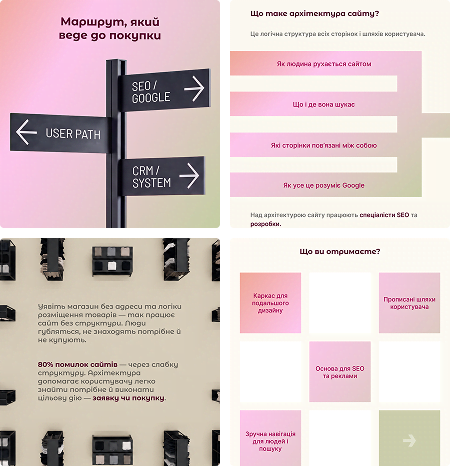
Site architecture is a large-scale system of data hierarchy and user interaction logic with a product that goes far beyond the usual menu at the top of the screen. Site information architecture includes:
User paths: clear routes a person takes from first encounter to targeted action.
Links between pages: logical linking that allows you to easily navigate between categories and services.
Information search algorithm: the speed and ease with which a client finds the answer to their query.
Search Engine Readability: How well the structure is understood by Google’s algorithms. SEO specialists always work on this stage together with developers. Together, they create a strategic framework that makes the architecture of the site as predictable for the business and user-friendly as possible.
Why a website structure, the creation of which was ignored, becomes a “black hole” for the budget: the main problem is its absence
When a website structure, created without analytics, lacks clear logic, a chain reaction of errors occurs. The user lands on a page but doesn’t understand where to go next. If the path to an application or purchase isn’t obvious, the visitor simply closes the tab.
A similar problem arises for search engines. Google perceives such a resource as an accumulation of unrelated data. As a result, the site becomes incomprehensible to the algorithms, is poorly indexed and loses positions in search results. The information structure of the site, built chaotically, turns the marketing budget into expenses without any return.
From Logic to Profit: How Site Structure Design Determines the Results of the Right Architecture for Your Business
Competent creation of a website structure gives a business clear advantages:
The basis for design. The designer no longer guesses at the placement of elements. He creates a functional interface based on logic, where the visuals emphasize the meanings, and not just fill empty space.
Predictability. You gain full control over the customer journey. Every button and transition is designed to lead the visitor to the target action without unnecessary thought or missteps.
The foundation for SEO and advertising. The architecture takes into account future promotion. Pages are prepared in advance for key queries, which allows advertising campaigns to work more accurately, and search engines to rank you higher.
Efficiency: Proper site navigation is speed. It allows people to instantly get what they want, and Google robots to index your content without error, increasing the authority of the resource. It is this invisible work that makes the difference between a site that simply “exists” and a site that truly dominates search results.
The Golden Triangle of Success: How Does SEO Site Structure Balance Business, UX, and Google Algorithms?
Modern website structure is a node where the interests of three parties are united. The business gets the opportunity to correctly present its product. The client gets a convenient service and a quick solution to their problem. And the SEO structure of the site ensures a balance of business, UX and Google loyalty, which directly affects the amount of organic traffic.
Rate your project
A website without architecture is a project that works haphazardly.
Key question
If you want your online resource to be a profitable asset, start by building a logical foundation. Examine your project and answer honestly the question: Do you have a site , or do you just have a set of pages where the customer can't find their way to purchase?