"Site under development..." is a phrase that for many entrepreneurs has become a symbol of wasted budgets and wasted expectations. While you are waiting for the launch, your competitors are already collecting orders. As part of the Do you have a site project, we decided to analyze this problem in the language of facts, not promises. After all, a site that does not bring customers is not an asset, but just another line in the list of expenses.

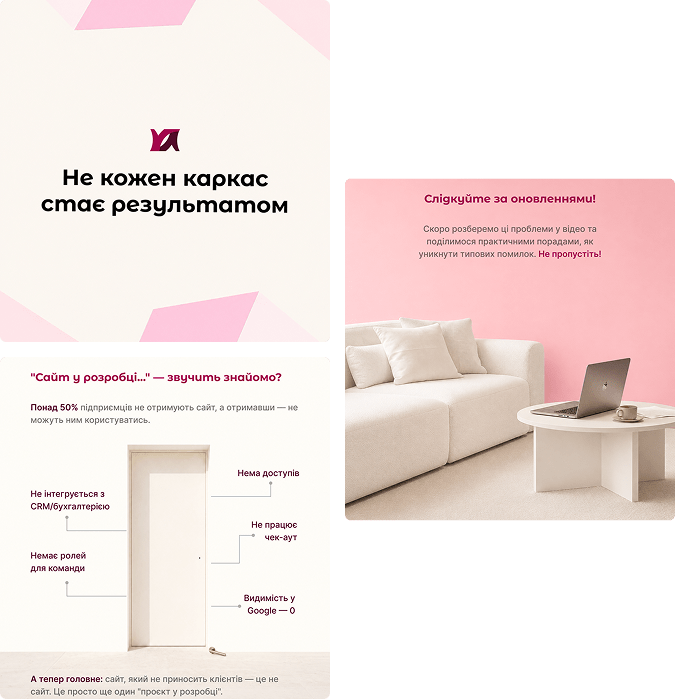
The statistics are relentless: about 50% of projects never reach release. The main reason is a deep gap between what the owner imagined and what the developer did. When developing a website for a business begins without a clear foundation, chaos ensues:
Lack of technical specifications. The promise “we will do everything well” is a path to nowhere. Without a detailed technical specification, the functionality is implemented at the programmer’s own discretion.
Uncontrolled revisions. Every new idea in the process that was not included in the budget extends the deadlines by months and increases the estimate exponentially.
Mismatch of expectations. The client expects a marketing tool, but receives a set of software code that has nothing to do with real business processes.
As a result, the project is frozen because resources are exhausted and there is no result.
A nice wrapper or a working asset? The main reasons why a website doesn't work for business
Getting a website is only half the battle. About 25% of entrepreneurs become owners of a resource that every morning provokes one question: why is the website not working for the business? This is a situation where "dead" functionality is hidden behind an attractive design.
When a website becomes a burden rather than a tool, it manifests itself through specific technical and logical failures:
Weak logic and functional errors. A broken checkout or complicated navigation forces the customer to go to competitors. If the order cannot be placed in 2-3 clicks, you are losing money.
Lack of integration with internal systems. The site exists in a vacuum from CRM, warehouse programs (1C/BAS) or payments. Instead of automation, you get hours of manual work for the staff.
Information and management paralysis. You can't change the price or add a product without calling a programmer. The lack of roles for the team makes you a "hostage" to the developer and constant bills for every edit.
Lack of analytics and “invisibility.” You don’t see the customer journey and don’t know why they abandon their cart. Without customized events, you’re moving blindly, relying on intuition rather than numbers.
And these are not all the problems the site owner faces. There are many of them, and they all turn the resource into an additional burden. Instead of a monetization platform, you get another “project” that is constantly being planned, finalized, and postponed “for later.”
What mistakes in website development turn the owner into a "hostage" of the contractor?
The worst thing is losing control of your own asset. Common mistakes in website development often concern fundamental security. You may not even suspect that the site is not actually yours.
You risk becoming a helpless "hostage" of the contractor because of:
Legal registration for third parties. Domain and hosting are registered to the developer's email. In case of a conflict, you instantly lose the address that you have been advertising for years.
Lack of "keys" to the system. You have no access to the server (FTP/SSH), database or admin. You cannot make a backup or change the support team.
Use of closed technologies. A "self-written engine", the architecture of which is understood only by the author. This is an artificial monopoly: other specialists will not take on this code, and you will be forced to pay any price for its work.
Full control of the resource is your security. All accounts must belong to you. Remember: the site is your property, not a "black box" with the key to it in the hands of an outsider.
Website as a sales tool: why without SEO your launch remains a formality
It’s worth finally admitting: a business website is not a digital business card, but a monetization tool. If you’ve invested in design, but search engines can’t see your resource, you’ve just opened an elite boutique in the middle of the desert. Customers don’t know about it, and Google ignores it.
A website as a sales tool has real value only when it becomes an active channel for attracting traffic:
- The site is invisible in Google (visibility "0")
- Complete dependence on paid advertising
- A passive "digital archive" waiting for a direct link
- A solid SEO foundation for top positions
- A steady stream of free organic traffic
- The client finds you on their own based on a targeted query
The comprehensive development of an online store or corporate website does not end with the release of the code. It is only the creation of a foundation on which your visibility should grow. Without a clear SEO strategy and understanding of the user journey, your resource remains in the status of "under development", even if it is formally launched.
More than code: what really goes into creating a full-cycle website for a business
To avoid becoming part of the sad statistics, you need to realize: creating turnkey websites is not about writing code, but about designing a business system. At GWD, we implement a full cycle of creating a website for a business, which includes 15 critically important stages:
- Initial communication and in-depth interview.
We don't just listen, we analyze the reality of your business today and plan for it "tomorrow." At this stage, the client manager becomes your main guide. This is a guarantor who knows the essence of all processes, is always in touch and is responsible for ensuring that your expectations coincide with reality.
- Niche and competitor analysis.
We study the strengths and weaknesses of competitors, their architecture and technologies. We look for your "added value" - what will set you apart in the market. The results of the analysis of narrow specialists agree with you and become the foundation of development
- Individual briefing.
We don't work according to templates. The brief is developed to your specific needs, taking into account the services that need to be integrated and your specific business requests.
- Architectural design.
This is the base that will be the basis for the success of your product's interaction with the audience. SEO specialists, together with developers, lay all the relationships, user experience, and search queries. This is the foundation without which further promotion is impossible.
- Development of a functional prototype.
We create a "skeleton" on which we test the logic of your audience's thinking. You see how the site will work before the first button is drawn.
- Brand design and visualization.
We create an interface based on your brandbook and emotional concept. Our approach is individuality instead of blindly following trends. The product should be holistic and strong even at the "beta" level.
- Formation of detailed TOR.
Your main document and protection. The technical specifications become an integral part of the contract, where every button and every function is recorded.
- Staging and work schedule.
Clear agreement on deadlines, obligations, and scheduled payments. This eliminates "surprises" in the cooperation process and ensures transparency at every step.
- Developing a launch SEO strategy.
When 75% of the project work is completed, the SEO team creates a strategy for further development. It is necessary to realize: the site will not be successful without a prescribed promotion plan. But for SEO to work, the resource must be technically perfect and comply with search engine algorithms.
- Strategy implementation and content creation.
We optimize each page with text, graphics, and video content. We populate the blog, product cards, and announce the launch on external resources. Everything is based on your niche's queries, which we "drive" to the site with the help of content.
- Multi-level resource testing.
Smoke test, Load test, and Pen test. We check every pixel against the design and every function against the vehicle to eliminate errors at the start.
- Technical optimization.
Final polishing of the technical state for the strict algorithms of search networks. This is the stage that ensures the site a quick start and high positions in indexing.
- Integration with third-party services.
We turn the site into a part of the business ecosystem: we connect CRM, payment gateways, logistics and warehouse programs (1C/BAS) for complete sales automation.
- Presentation and further planning.
We deliver not just a set of pages, but a working business tool and together we plan how to double your payback indicators.
Only such a consistent approach guarantees that the development of an online store or conversion platform for your service segment will end in profit, not disappointment.
From illusion to profit: are you ready to order a turnkey website that will become the foundation of your payback?
Website creation is a synergy of marketing and development. It is not a one-time service, but the joint work of a team that takes responsibility for the results of your business.
Today, it is not enough to simply order a website; it is important to get a system that will:
Will have high organic reach and occupy positions in the TOP.
Synchronized with your CRM, warehouse programs, and analytics.
Simple, convenient and intuitive to manage for your staff.
Able to withstand heavy loads and provide systematic sales.
Digital strategy for a business website starts with choosing a partner who sees not only the code, but also your profitability. Stop settling for “process for process’s sake.” Your business deserves to finally get out of the exhausting zone of “eternal development” and start making money.
Let’s face it: if your resource’s visibility in search engines is zero, you don’t have a website. You only have the expensive illusion of an online presence that no one but you and the developer can see. The real work doesn’t end with the handover, but when sales become systematic and processes become automated.
So the only question is whether you are ready to continue investing in the illusion of an online presence, or whether it is time to order a turnkey website that will become a real tool for scaling your profits.
The request “make it beautiful for us” is a classic, with which the lion's share of requests begin. However, in the professional industry, “beautiful” is not a technical parameter. Professional website development begins not with design, but with the foundation — a clear technical task. It is on how detailed you formulate the request that the speed of the release, the accuracy of the implementation of your ideas and, ultimately, the final cost of the project depend. But is it possible for a business to prepare the terms of reference for website development on its own? Let's figure it out.